Instead of getting ChatGPT to write our emails, or an AI assistant to sort out our messy work calendars, what if we tasked the technology with something more advanced? Surely we should be thinking a little bit bigger – like, transforming our entire economy into something bigger?
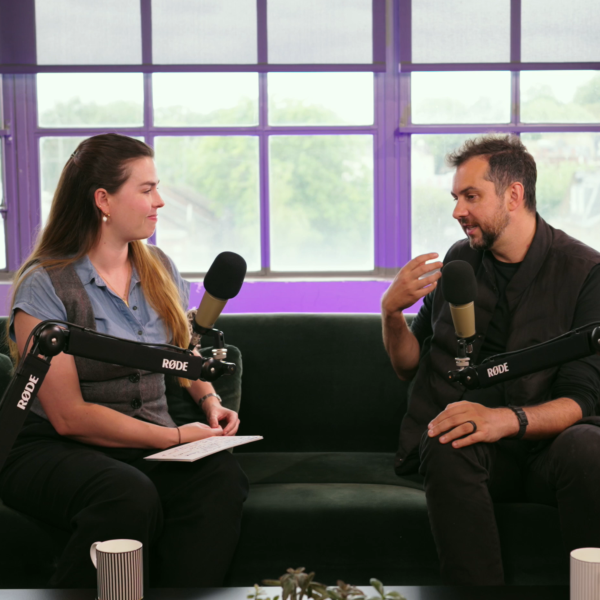
According to CEO of Satalia and AI expert Daniel Hulme, we absolutely should think bigger. And not just about the impact at a personal or even organisational level, but the potential AI has, to be at the core of every element of economics, rather than just as an add-on or tool.
Let’s dive in and see how AI could completely change workplaces, roles, priorities and our collective lives if we’re ready – and willing – to create an AI-driven economy.
First things first: what would an AI-driven economy look like?
Currently, our economy is driven, pretty much, by human wants and needs. We need a warm house in winter, so we dig coal out of the ground, build nuclear power stations or import electricity. We want a Netflix subscription or a Rolex watch, so we pay a monthly fee to access the database or go to a watch shop.
Behind all of that, there are endless teams, organisations and even entire countries dedicated to pushing goods, services and data around the planet. Practically all of the associated processes, communications and any other type of work are still being done manually, by humans.
In an AI-driven economy, meanwhile, almost all of the decision-making, communications, admin and even things like marketing could be vastly enhanced and made more efficient by AI – with our oversight, of course.
Here’s a scenario. Imagine you’re buying a roast chicken. The farmer has raised the chicken using AI to source the best feed and apply an AI-optimised care plan. The buyer at the supplier or supermarket purchases the chicken, using AI to find the farm, determine the correct value and ensure a more sustainable food industry supply chain, and then negotiates the sale using AI to write the correspondence and administer the paperwork.
AI-driven logistics systems then transport the chicken to be processed, maybe by a self-driving truck. Another AI tool measures, weighs and checks the chicken for quality (feeding everything back to the farmer and the Department for Environment, Food & Rural Affairs to comply with welfare regulations), before an AI-powered robot processes, packs and ships the chicken off to your supermarket of choice.
Next, the supermarket’s AI helps to get the fresh chicken from the warehouse to the chicken counter at a much faster pace than a human could, before an AI-enabled oven roasts the chicken to precision.
Then, you, or your AI assistant, buys the chicken – with AI tracking the purchasing data, collecting your feedback and pushing everything back down the chain to enhance efficiency, quality and any other optimisation factors.
Oh, and the market stocks of the farm, the supplier and the supermarket? All traded on an exchange that uses AI extensively to buy, sell and predict.
Now apply that level of AI integration to pretty much everything else you do daily at work, and you have something that looks like an AI-driven economy – with humans still at the wheel.
What will happen to my team?
As you can see, a lot of jobs have been taken out of that hypothetical scenario. For example, if you have teams of staff that pack chickens, that AI robot may seem like a threat. But, vitally, the economy is always going to need people. Who’s going to fix the machine when it inevitably breaks down? And who will write the prompts, check quality and look for ways to continuously improve operations?
AI-driven economies shouldn’t be about looking to reduce headcount using AI. They should be optimising processes to rocket-propel growth, efficiency and ultimately profit, to the point where you’re growing your team rather than reducing it.
In an AI economy, instead of traditional manual or administrative jobs, humans gain significant governance over systems and ‘employees’, giving us infinitely more control. We take the helm, telling AI what to do, improving it, and generally doing less work for a bigger outcome, all while delegating the work we’re used to doing right now.
Imagine you take your team of 50 chicken packers and give them 10 robots each to look after. That’s now a team of 550 for the price of 50, plus your initial investment costs. You’re going to need more chickens.
Beyond the job loss panic that the media focuses on, there’s actually quite a lot of optimism from some of the biggest names in employment to back up this thinking. Take the founder of LinkedIn, Reid Hoffman, who believes that in the near future, the 9 to 5 will be extinct.
According to Hoffmann, as AI becomes more ubiquitous, we’ll be working less, earning the same or more, and living generally happier lives, with menial tasks like turning up for work or booking a dentist’s appointment completely handed over to AI assistants.
But back in the present, Satalia founder Daniel Hulme believes that one of the best current applications for AI at work is to remove ‘friction’. So what does that mean?
Well, imagine you’re trying to figure out who your best customers are. Except that means trawling through 50 spreadsheets, and the spreadsheet department won’t give you the resources you need. If you could get AI to quickly summarise all of that data for you (this already exists, by the way), then you don’t need extra resources, and the spreadsheet department is off the hook.
“Any friction that exists within a company, you can apply technology to alleviate,” says Daniel.
Here, you can see straight away how AI isn’t just about replacing jobs, it’s about unlocking new opportunities without the need to hire someone else or ask someone else to do something for you.
An army of one
Does anyone remember that Bruce Willis film, Surrogates, where humans could replicate themselves to avoid having to leave their homes in a dystopian future? Or, slightly more abstract, Avatar? That kind of replication already (sort of) exists, in the form of AI agents.
You can train existing AI software – even the ubiquitous ChatGPT – to sound like you, make decisions that you’d be likely to make, and then feed it simple jobs like writing a response to an email, or creating an article, book, or anything else. You may even already be doing this.
Looking at how fast OpenAI got into our households; it isn’t a stretch to imagine that in a couple of years, we could be telling our AI assistant to draft responses to our full inbox without even having to unlock a device, or getting it to just do it automatically.
So let’s go a little sci-fi for a second. What happens when the tech catches up and you can buy an anthropomorphic robot or AI double that is able to go and do the jobs, chores or even chase an entire career in the same way you would? And what happens if you could simply upload expertise like a degree, or even do away with annoying things like sleep, going to the toilet or doom scrolling on Instagram?
This is possibly how we need to think. Instead of worrying about AI taking our jobs, we can simply use AI to streamline our jobs in the same way we’d do it, or better.
How could that look in the future? Well, with lots of brainpower suddenly handed over to a highly-refined set of AI assistants that don’t need to finish working at 5pm, the typical boardroom / investor / employee model could be gone forever. Maybe individuals, with the ability to suddenly connect other people and processes using AI models with little effort, could run an entire Fortune 500 company with a handful of prompts.
The bigger picture
Beyond our immediate employment, an AI-driven economy could offer even more opportunities than those provided by smart AI integration. As an example, consider the recent massive investment in the UK from tech firm Microsoft – to the value of $30 billion. The investment – and speculation – attached to an AI-driven economy has obvious benefits, especially somewhere like the UK that is heavily set up for tertiary industries like tech and communications.
Then there’s the impact AI will have on us beyond the workplace, which still has a direct impact on our work. At the basic level, what about AI apps and services that help us to eat better, exercise more and improve our sleep, turning us into better workers? Or, in the near future, AI medical technologies that help us treat or even cure common diseases and conditions, meaning we’re working more, and for longer?
Work in an AI-driven economy isn’t just about whether we need to update our CVs; it’s about how we prepare ourselves for inevitable change in our day-to-day lives. Driverless cars, AI voice assistants that handle your mortgage renewal for you, or your AI agent proof-reading that big presentation, could all contribute to a shorter, less stressful and infinitely more productive work day.
Oh, and there’s also the part where AI can do stuff that would take us years, or even decades to master. Take Neuromorphic AI, which, a bit like a human brain, can recognise patterns and look for repetitions but without the vast amounts of power that a large language model would require to do similar.
So, what on earth would we do with all the spare time?
Apart from the obvious – see our families more, go travelling, play more golf – there lies a gigantic opportunity for humanity to start getting rid of the stuff we usually park in favour of working harder to make more money.
If we’ve streamlined most of the daily grind with AI, and are in ‘oversight’ mode, we could do more charity work. Or figure out how to solve drought, crop failures or climate change. Or we could quadruple the size of organisations like the UN and figure out how to stop fighting with one another.
Possibly, we’d simply fill our time with more work. If we’ve got the bills paid thanks to AI doing some of the heavy lifting with our supervision, we’re free to pursue all the side hustles we’ve ever dreamed of, or to set up another business that doubles our income. And as the technology progresses and AIs become more capable, then the sky really could be the limit.
Maintaining control
Almost all of humanity’s economic decisions and disasters have come from our own, often poor decision making. War, bubbles, overvaluing, speculation and simple panic dictate our booms and busts. And if those are the determining factors of whether an economy is booming or busting, then what else are we meant to teach an AI?
With smarter-than-human intelligence possible in as little as a decade, Asimov’s rules could be deployed quicker than we’d ever imagine to avoid biased thinking. The ‘learned’ AI bias is rooted in human thinking, and can go from being an echo to a serious problem.
“One way to address bias is through a concept called “agentic computing,” says Daniel.
“This involves using specialised, biased AI agents for different domains, each representing specific knowledge or perspectives. By having these agents collaborate and argue, we can achieve better solutions, much like diverse human teams bring varied perspectives to solve problems.”
Like any life-altering technological advance, the safeguard needs to be there from the beginning. Common singularities – the potential and often likely negative outcome – of AI are vast.
Whether that’s AI wiping out humanity to solve climate change, or AI following erroneous or dangerous algorithms in pursuit of ‘Hey Siri, make me rich, quick’, you could build an entire economy around controlling and keeping AI in check if it finds itself making our biggest decisions for us.
So here’s a parting thought: If labour is suddenly almost free, smart robots are farming our crops and extracting minerals from the ground, and we’re enjoying the most free time we’ve ever had, is there actually a need to attach value to anything anymore?
What would an economy look like where our supermarket chicken was almost entirely delivered to us by AI, therefore requiring no meaningful payment? If the whole idea of going to work is to earn money, then do we even need to work anymore in a world where everything is free? Let us know – join the discussion on LinkedIn.