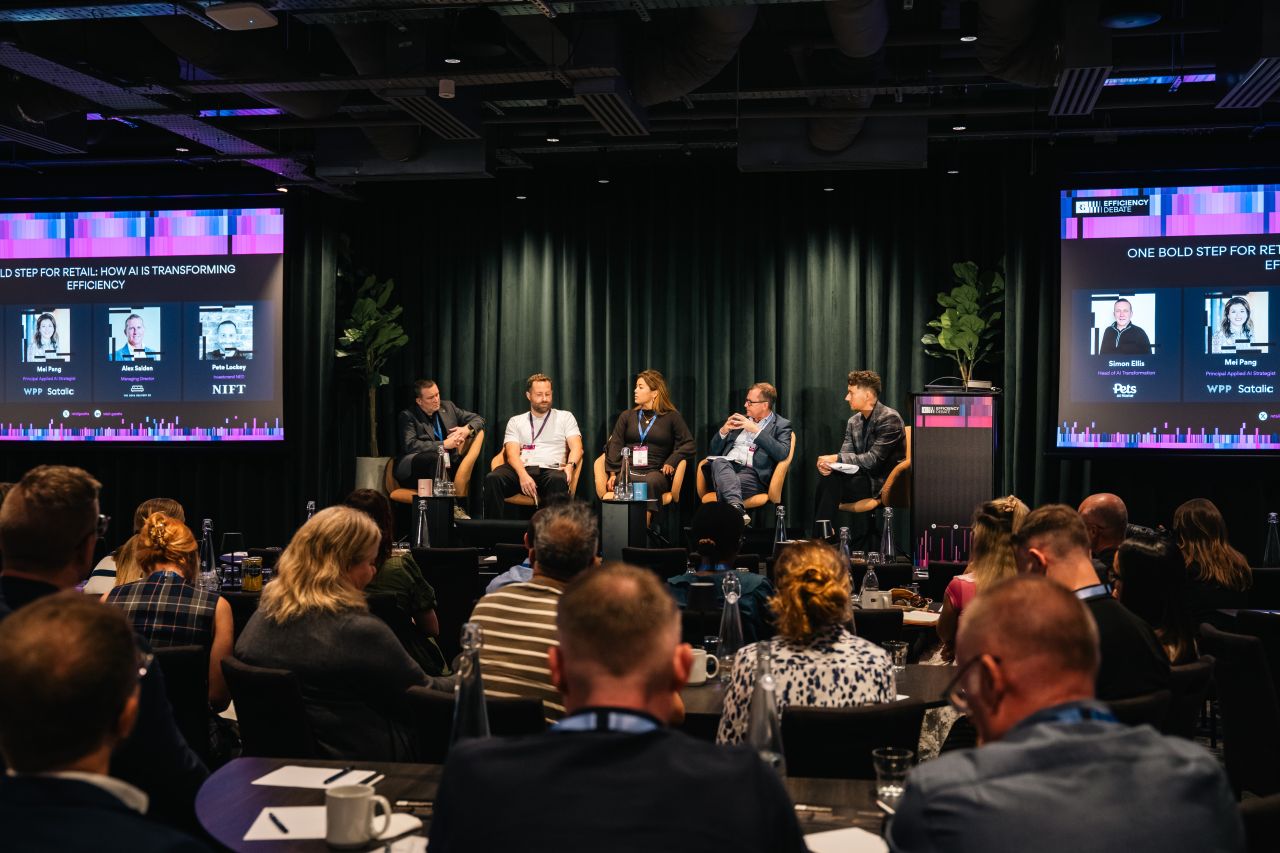
How is AI helping retailers transform efficiency and solve business-critical issues right now – and what does the next wave of AI hold for the future?
At last week’s Efficiency Debate by Retail Gazette, I had the pleasure of discussing just this with my fellow panelists Simon Ellis, Head of AI Transformation at Pets at Home, Alex Salden, Managing Director of the Sofa Delivery Company, and Pete Nockey, Investor and Non-executive Director at Need It For Tonight.
Moving past the noise that’s surrounded AI since its mainstream debut, we focused on practical examples of how the technology is removing points of daily friction, supporting better decision-making and delivering measurable outcomes.
The dynamic AI landscape is ripe with innovation. Where we’re headed next as the tech continues its evolution is something to prepare for now. For those of you who weren’t able to join us on the day, here are my insights into closing the gap in executing complex retail operations – and what to expect from AI in the coming 12 to 24 months.
Solving today’s problems, today
We hear a lot about the flashy GenAI hype. But for me, the biggest challenges we’re solving right now are through more traditional AI – the kind that uses mathematical and scientific algorithms to bridge the divide between retail strategy and execution.
Retailers are drowning in data but translating that information into measurable efficiency in real time is incredibly difficult – at least for humans. At Satalia, we apply machine learning and advanced optimisation to data, solving legacy problems like delivery routing or workforce scheduling in seconds.
It’s through traditional AI capabilities, expertly applied, that we’ve been able to deliver measurable results for our retail clients, like an 18% fuel efficiency increase with our last-mile delivery solution or four weeks’ extra capacity per person, per year with our workforce solution.
Our projects are built to deliver immediate results, to solve today’s problems today, but that’s because our brand of AI is specialised and rooted in decades of experience. Expecting the same results from an off-the-shelf probabilistic tool is unrealistic. So is beginning from the wrong starting point.
Debunking the industry myths and misconceptions
The biggest misconception I constantly challenge is the idea that AI is some plug-and-play silver bullet. Too many retailers think of AI like a software purchase, assuming that if they just buy the tool, their supply chain or pricing issues will magically disappear. Unfortunately, that’s just not the case.
AI is an operational capability and as such, the focal point should be the business problem, not the shiny new technology. Retailers must talk to end-users to understand the problem, not just the tech teams.
We need to be pragmatic and focus on solutions that actually drive efficiency, which means avoiding three major myths:
- First, there’s the “GenAI First” trap. Generative AI is fantastic for language and creativity, but it won’t optimise your delivery routes or manage an inventory matrix. For real operational efficiency, you need traditional deterministic AI and hard math.
- Second is the Data Myth – the belief that your data has to be perfect before you start. It doesn’t. No one has perfect data, you just need data that is good enough to solve a specific, scoped problem.
- Finally, people completely ignore the Operating Model. AI doesn’t work in a vacuum. If you don’t change the human processes around the AI output, you just end up with an expensive tool that nobody uses. An operating model is a combination of people, processes, data, and technology. If the AI is the tool, you have to design everything else around it.
To understand what real AI adoption actually looks like, our teams at Satalia don’t just sit behind desks: we send our people out to ride in the delivery vans and work in the warehouses. We do that to get a true, gritty feel for the daily challenges the clients face on the ground.
This is how we ensure we’re building tools tailored to their actual needs – tools we know will be adopted and drive enormous value from day one rather than hanging around in a pilot stage because we didn’t accurately define the objectives.
Moving beyond experimentation
It’s common for AI projects to languish in the experimentation stage. Moving past this point comes down to shifting from a ‘tech-first’ mindset to a ‘problem-first’ mindset.
The retailers struggling in ‘pilot purgatory’ usually start by saying, ‘We want to use large language models, where can we put them?’ They build cool proofs of concept that look great in a boardroom but never scale.
Successful retailers do three things differently:
- They ruthlessly anchor AI to KPI impact: They identify a specific friction point – like warehouse bottlenecks or customer churn – and define exactly what success looks like in pounds and pence before writing a line of code.
- They design for the end-user from day one: If a store manager or a delivery driver finds the AI tool cumbersome, it fails. Winners focus heavily on user experience and change management.
- They treat it as a cross-functional sport: They don’t lock AI in the IT department. They put data scientists, operational leaders and commercial teams in the same room. The technology is often the easy part; aligning organisational behaviour is where the value is unlocked.
Satalia builds solutions that integrate within the existing ecosystem. We help clients become ‘AI-first’ by focusing on solving problems, always having the end user in mind and ensuring everyone is on board with any changes.
What does AI-first really mean?
Being ‘AI-first’ doesn’t mean replacing your workforce with robots or using AI for every single task. It simply means that when a new business problem or opportunity arises, your default approach is to ask: ‘How can data and algorithms solve this at scale?’ instead of ‘How many people do we need to hire to throw at this?’
If leaders want to build that foundation today, they should start by taking two practical steps:
- Demystify AI for leadership: Move executive education away from science fiction and toward practical capability. Leaders need to understand what AI can and cannot do.
- Build an experimentation framework: Create a safe, fast-tracked environment where teams can test an AI hypothesis in four to six weeks, measure the ROI, and either kill it or fund it immediately. Speed to value is the ultimate competitive advantage.
What’s next?
The next major evolution we need to prepare for is the shift from reactive AI tools to truly autonomous operations – what the industry is calling “agentic” systems.
Right now, AI gives us recommendations: it suggests the best route or the ideal inventory level, and a human has to hit ‘approve’. But over the next couple of years, we’re going to see highly integrated autonomous AI ‘agents’ make and execute these decisions across silos in real-time.
Imagine a weather disruption hits: an AI agent will automatically re-route the delivery fleet, sync with the robotics in your fulfilment centres to adjust warehousing schedules, and update customer ETAs simultaneously – completely without human intervention.
But as agents start accessing websites, executing searches and pulling triggers on their own, compliance and security will become absolutely critical. You cannot have autonomous agents running your operations if your core systems can’t securely talk to one another.
That’s why at Satalia, under the WPP governance framework, we’re helping businesses build robust control systems and a unified digital backbone today. Your AI strategy cannot be a collection of isolated, departmental point solutions; it has to be driven at a company-wide level.
And this isn’t just happening on the operational side: it’s completely rewriting AI commerce. We’re heading toward a world of personal AI agents, where consumers will use their own agents to shop, search and buy for them.
As retailers, our entire marketing and business strategy will have to shift. We won’t just be trying to influence the human consumer anymore; we’ll have to learn how to optimise for and influence the agent deciding for them.
To summarise:
- Do not dismiss other types of AI amidst the GenAI hype. Satalia specialises in AI-driven advanced optimisation that delivers real, measurable business impact.
- An AI-first organisation doesn’t mean replacing all your workers with agents to solve a friction point. It simply means asking, “How can I solve this problem at scale with data & AI?” rather than “How many more people do I need to throw at this issue?”
- Anchor your investment in AI to KPI impact. Define what success looks like. Ruthlessly assess the ROI.
- Always start with the problem, shifting from a ‘tech-first’ to a ‘problem-first’ mindset.
- Think about the wider operating model impact (people, process, technology, data).
- Set up an experimentation framework. Define the hypothesis, determine how you’re going to test it, test it over a short period, and then kill it or fund it immediately.
- Demystify what AI can and cannot do. Keep track – it’s evolving!
- Do it all with rigour, the right security protocols and governance frameworks.
Final thought:
‘You can have the best AI solution, but if no one is adopting it, it’s already failing.’
A huge thanks to my fellow panelists Simon, Alex, and Pete, our moderator, and to everyone who came by to continue the conversation. See you again next year!